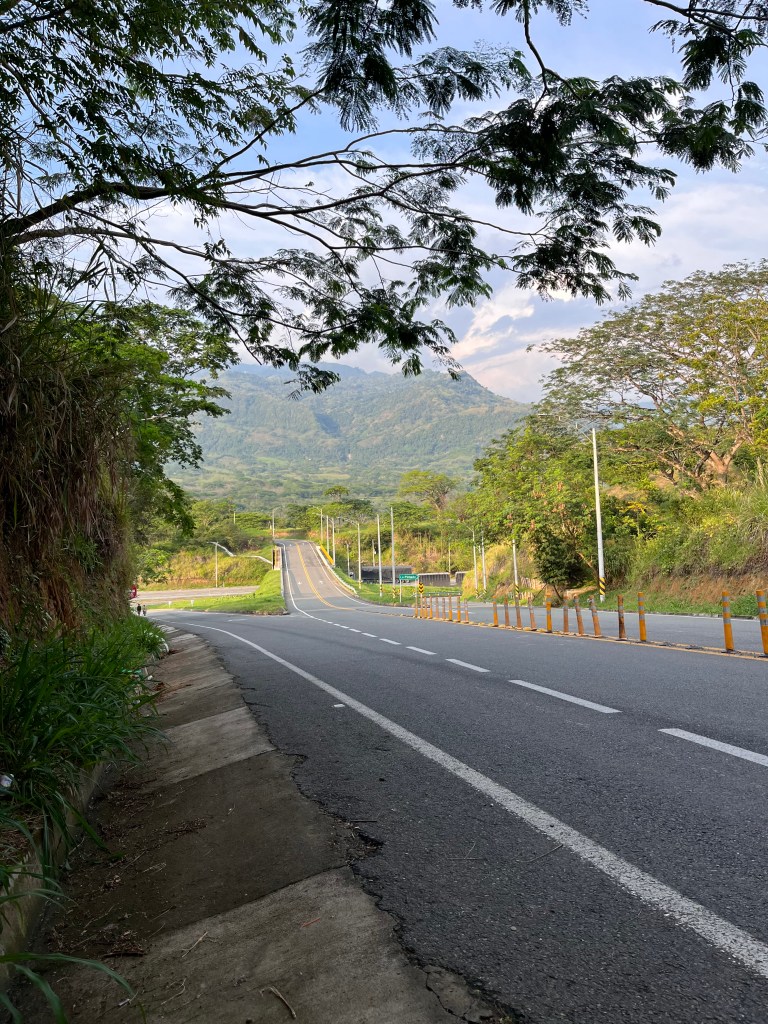
Usually, when traveling by bus, I get from point A to point B with little more hassle than it takes loading my bag into the luggage compartment. But this time, I had to push my way up to the bus driver, tell him my destination, and then get dropped off on the side of the main artery that runs through this part of the Central Colombian highlands. I crossed the highway with my 40-liter bag on my back and my 20-liter bag slung over my arm and waited for a bus that, according to the driver, could arrive at any time.
After crossing the highway, I dropped my bags near the entrance to the road leading to Jericó, Colombia. I had visited the small town a few weeks earlier. I decided to return to volunteer at the only hostel in town for two weeks, hoping to buy some time before continuing my journey to an undecided location.
After an hour of alternating between squatting on the curb and pacing on the shoulder of the road, I started to get worried. While I waited, I remembered a lesson I learned while traveling through Latin America up to this point — people are often eager to help when you’re lost or confused, but there’s a high chance the information they give you is completely wrong. In this part of the world, the principle of helping someone in need seems to be more important than the help itself. Now, I wasn’t feeling so grateful to the bus driver and his vague instructions. He just told me to cross the road, sit near the entrance, and wait.
As an hour slipped by and the sun dipped below the mountains, 5 o’clock came, and I guessed I had about an hour left before it got dark and I’d be stranded without a plan. Jerico was a 40-minute drive down a winding mountain road from where I currently stood, and I considered starting to walk towards the direction of the village before I ended up settling on what became my first attempt at hitchhiking. Thankfully, a well-timed local bus headed toward the village arrived about 10 minutes after I started my pathetic attempt at flagging down a ride. During those 10 minutes, as I stuck my thumb out, I hoped deep down that no one would actually stop and offer me a ride. I tensed up whenever a car approached, and I averted my gaze to avoid the awkward moment of locking eyes with the driver, no matter what the outcome might have been.
Besides, around this time in my Latin American journey, I still struggled to firmly say “No” and stand my ground whenever I was confronted by an uncomfortable situation or an overly insistent person. How could I deny a ride, even if the person picking me up had a creepy look in his eye? Still, I continued to stick my thumb out as if it were an obligation. Although this first attempt was technically a failure, it was still a step in the right direction.
By the time I successfully hitchhiked for the first time in October 2023, around 7 months after my first attempt, I had about 9 months of solo travel under my belt and, thankfully, a bit more knowledge on how to navigate the situation.
Despite my initial fear of hitching a ride, I later felt that it was something I needed to achieve, or at least attempt, before I got home. I made a promise to myself to give it a shot the next time the opportunity arose, this time with the proper preparation — cardboard sign and all. I wanted to test my limits by trying something that seemed truly unpredictable; the antithesis of the punctual green Flixbuses I had been taking through Europe and Latin America up until this point. I wondered if I could handle the added pressure without cracking under the stress of trying to find a ride before sundown, or in the rain, god forbid. In the same manner that I spontaneously decided on destinations as I traveled, I wanted to be able to roll the dice on the way I’d get to these places, and who I’d be able to meet along the way. After all, for me, the interactions I have with people are by far some of the most impactful things I encounter on my travels, much more than the monuments that rarely ever impress me enough to cause me to stand and stare for more than a minute before I walk off, uninterested again.
My strong desire to hitchhike was also fueled by my sudden pivot towards apathy only a few months after beginning my solo journey through Latin America. It was around the time I arrived at the Nicaraguan Island of Ometepe, around a month before I tried hitchhiking to Jerico, that I recognized this feeling in myself. This island and I had a history that no one else knew about. Sometime in the mid-2000s on the family computer, back when I had a strong fixation on all things geography, I would travel the world on Google Earth and hone in on geographic anomalies that stuck out on the globe. One of these fixations of mine was a massive lake in the middle of Central America that looked as if it would spill out into the Pacific if not for a thin strip of land keeping it contained to the jungles of Central America. In the middle of this massive lake was an island with two large stratovolcanoes jutting out of it, connected by a strip of land in between. The island fascinated me enough for me to keep coming back to it and look at it from different angles, all while images of stereotypical island natives ran through my mind. I wondered if it was really as incredible in real life as it looked through the satellite image.
Now that I was on the island, some 15 years later, I was a little bit hurt that I didn’t feel at all like I imagined I would. Although I was enjoying the adventure of exploring the island on a rented motorbike, I still felt at times that I could have been anywhere in the world if it weren’t for the omnipresent volcanoes piercing my view of the sky at all times of the day. The feeling that followed this general lack of emotion was one of worry, enough to make me believe that maybe I hit a high at the beginning of my travels that can no longer be reached again. When I first started backpacking, I did feel this excited energy in my belly (some attributed to anxiety coupled with an intestinal infection), but after a few months, high expectations inevitably collided with reality. After all, even if you’re in your dream destination, life still goes on, good and bad alike. Like the German girl named Sara told me on Ometepe Island after we talked about this very subject, “every day cannot always be an adventure.” Hitchhiking, then, was a way for me to take control and maybe find some sort of feeling that I thought I was missing. Ironically enough, taking control also meant leaving it up to others to take me where I needed to go.
——–
Months after my Latin American trip ended in July of 2023, I began a new journey in Europe in September of the same year. Starting in Germany, I made my way south towards Austria and west into Switzerland, traversing the Alps until I finally crossed into France for what I expected was going to be a month of proper French language immersion. In Europe, I was living frugally as I usually do; staying with friends that I met a few months earlier in Central and South America, taking Flixbus, and buying 1€ baguettes and salami from Lidl. By early October, as I crossed the border into France, I had already stayed with 2 friends in Germany, one in Austria, one workaway host outside of Zurich, and two other friends in Bern and Geneva, respectively. So far, so good, I thought to myself. I managed to survive on less than 1000 euros for a month in one of the most expensive regions in the world. Yet, a problem presented itself soon enough. I only had two friends in France that I could visit, and a whole month to pass the time.
I decided to try something different by signing up for Couchsurfing, a website that connects you with locals willing to host a traveler for a few days, free of charge. Unlike the Workaway website, there is no formal agreement to work in exchange for accommodation. The only thing that is unofficially expected, as I later found out, is to offer good stories and unceasing conversation. This website opened up a whole new world to me, far different from hostels, and a better opportunity for language immersion. The ounce of courage it took me to show up to my first couchsurfing host in Avignon, France, helped to give me a little extra push to consider hitchhiking again. After all, I was in France, a relatively safe country, with a good reputation in the backpacking community as a haven for hitchhikers, in a world that regularly demonizes the practice.
The final push that sent me over the edge was two Ukrainian girls who were also staying in the apartment that served as our temporary shelter in Montpellier, France. We had different routes and destinations, but for a day and two nights, our paths crossed in the same Couchsurfing host’s cramped apartment. The girls were from Kharkiv, Ukraine—a city that was on the frontline of the ongoing war with Russia. After some conversation, they revealed that they were traveling—almost exclusively by hitchhiking—from their hometown in Eastern Europe all the way to southern Portugal on the far western edge of the European continent for the sole purpose of enjoying the warmth and beaches of the Algarve. Two girls, younger than me in their early 20s, did this great trek by hitchhiking and pitching tents on the side of the road when they weren’t staying with Couchsurfing hosts. I remember thinking, “What an incredible amount of courage they must have to do this, and how could I do the same?”
I asked them question after question, and they answered casually and matter-of-factly, as if these questions had obvious answers (which, I admit, some might have had). They directed me towards some resources, the most useful of which was HitchMap.com — a website that consisted mainly of a standard Mercator projection map of the world, dotted with red, yellow, or green dots, placed there by website users. The colors of the dots indicated the ease with which they were able to be picked up by drivers, green being the fastest and easiest, red being the most difficult and least recommended spots to be picked up by motorists, and yellow being somewhere in between. Each dot could be clicked, and some had further details written by the person who placed the dot in the first place.
For example:
“Good place for cars to slow down. Most are going west towards the coast. —Anonymous, August 2018”
This at least seemed to solve my biggest and most important question of “Where do I stand and stick my thumb out?”. The ideal spot was somewhere I could get to by public transport, and that was connected to the city center. That way, if anything went wrong, I had the option to go back into the city and consider other, more conventional ways to get to my destination. I also looked for spots that were near roundabouts, where drivers are slower, have room to pull over, and where you can work your magic by looking them in the eyes and hoping they feel bad for you.
The last issue to address was my sign. I had anticipated the possibility of hitchhiking before I left home in September, so I packed a notepad with large, thick white sheets of paper, originally meant to serve as a sturdy canvas for acrylic paints, along with a thick black marker—just in case this sort of situation came up. The girls didn’t like my intentions for the brand-new notepad, even more so because one of the girls was an artist and felt that I would be using good-quality paper for something that could be substituted for cardboard. Naturally, I traded the 20-dollar notebook for a piece of cardboard they scavenged from the local supermarket.
I carefully wrote the name of my next destination on my piece of cardboard, making sure to write the letters capitalized, bold, and thick. After I got their approval on the font size, we closed out our last evening together with a dinner of fried potato pancakes made in the Ukrainian style, courtesy of them.
The next day, I woke up earlier than anyone in the apartment. I showered, packed, and walked out onto the street with a nervousness that was steady and growing by the minute. I had looked over the map the night before and decided that my best bet was to follow one of the green dots situated in the southwest corner of the city. The roundabout that I was looking at was at the end of the tram line that ran from the center of Montpellier, allowing me an escape route. By the time I got to the end of the tram line near the roundabout, I felt as if I was about to go on stage to perform for a room full of hard-to-impress French people.
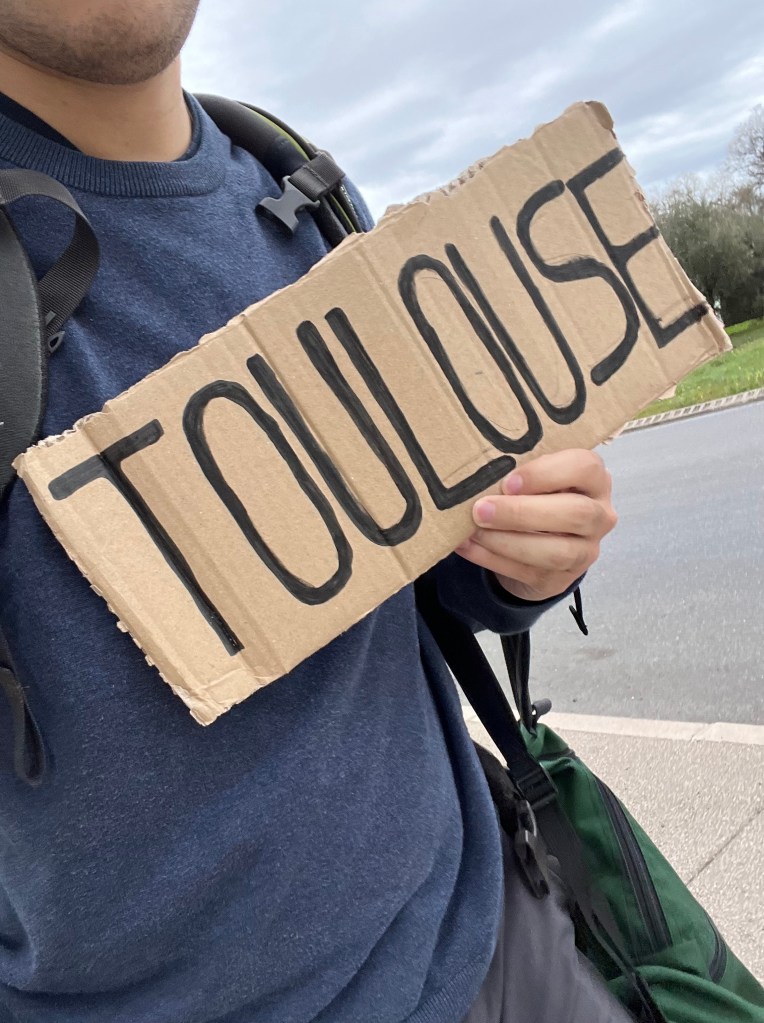
I took my place on a corner, next to the entrance of a road heading west. I dropped my bag and timidly held up my sign with the word ‘TOULOUSE’ written on the scrap of cardboard that once held local produce. With my right thumb out, and the sign held to my chest with my left hand, I worked through the awkwardness by reminding myself that I would never see these people again, and began my performance by giving a friendly half-smile to anyone who gave me eye contact. Right away, I started getting reactions. Most drivers simply went along their way and avoided eye contact, but more often than anticipated, I received a few people shrugging and mouthing “Desolé”. It didn’t take long before I felt comfortable enough to seek out the eye contact, instead of avoiding it.
I’ve since learned a golden rule of hitchhiking: a large part of being successful is looking friendly, clean, and like you smell good. At the end of the day, you’re selling yourself, hoping someone finds you interesting enough to be worth their time. My freshly shaven baby face and new sweater must have looked welcoming enough, since to my surprise, it took only 20 minutes before a woman turned on her blinkers and pulled over. I can’t remember what was said after she rolled down her windows, but I eagerly chucked my backpack onto the backseat of this middle-aged woman’s car, and I jumped in behind it. For the most part, conversation was limited due to my elementary level of French, but she was friendly to me.
After 2 hours of awkward, sporadic conversation, I got dropped off in front of an overground entrance to a Toulouse metro line, and made my way into the center of the city easily from there, right before it rained. It really couldn’t have gone smoother, and I couldn’t help but feel so content with myself. More than anything, I was proud. I did wonder if this was a one-off experience, or if this was some newfound travel hack that could take me through France for little to no money, all while getting free French lessons. Naturally, I tested this theory a few days later.
I had spent the last couple of nights in a very nice apartment in central Toulouse, where I had my own large bedroom, with a soft king-sized bed, a desk, and even a balcony overlooking the city. The catch was, my host was a soft-spoken nudist who did not offer anything in conversation whatsoever. Every night that we had dinner together, he would slip off his pants and sit very awkwardly next to me on the couch while we watched the French evening news. We rarely ever said a word to each other, and I would escape back to the privacy of my room after I tried to ask a few probing questions, to no avail. At the end of the day, all I needed was a good review to better my chances of getting another place to sleep in the future.
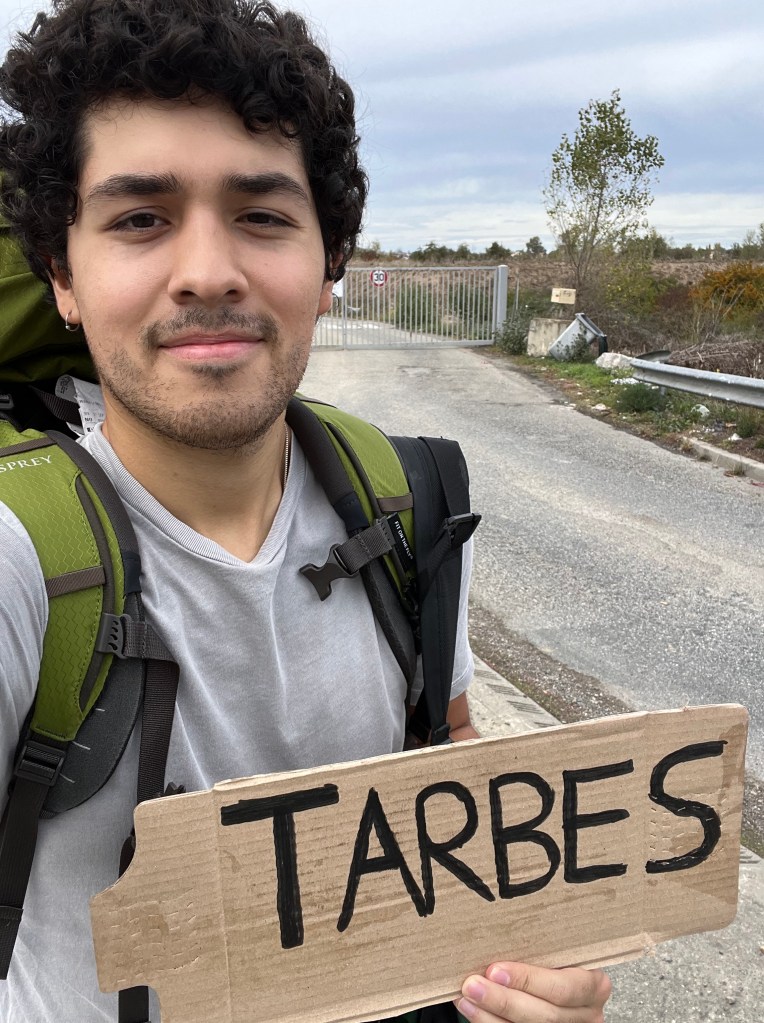
At the end of my lackluster time in Toulouse, I picked up some more cardboard, arranged for my next couchsurfing host in a town called Tarbes, and found a spot that looked good enough to hitch from on Hitchmap.com.
Once again, I was picked up in less than 20 minutes — twice! And I was lucky to have some great company to pass the time this time around. The first ride of the day came from two twin brothers who took me to a better spot where I could catch a ride. They told me that my original location wasn’t ideal if I wanted to head west, and they offered to relocate me to a roundabout just outside the city, where more drivers would be traveling toward the Atlantic coast. After dropping me off, they wished me good luck and went on their way.
After waiting at the new spot for only a few minutes, several people pulled over to offer me rides. When they explained they weren’t going directly to Tarbes, but instead to towns in the general westward direction, I declined, hoping to recreate my luck and get a ride directly to my destination, like I had going to Toulouse. Sure enough, it only took 15 minutes to get lucky. A young girl, around my age, was heading towards Tarbes by herself. After I stuffed my bag into the trunk and got in her beat-up sedan, I asked her why she decided to pick me up, and her response was a quick and simple, “ You looked friendly!”. I couldn’t say much to that!
After I started the conversation in broken French, I understood that she worked and lived in Tarbes, on a small farm where she worked as a horticulturist. She reminded me of a few other people I’ve met before on my travels. She had long hair, fair skin, and was, by all accounts, a hippie. It didn’t take much time to feel at ease and comfortable with her, as she did with me. We enjoyed the rest of the ride listening to music and having a good conversation before she dropped me off in front of the Hôtel de Ville. I sat down and had a beer at a café until my couchsurfing host was ready to receive me, just as it got dark outside.
My final ride toward the Atlantic coast was planned for the French city of Bayonne. I had already arranged to stay with a Couchsurfing host in Bayonne before heading to a small Basque village just south of the city, called Biriatou, to celebrate my birthday weekend with a friend that I had met in Colombia.
The village was situated on the Spanish border, and all I wanted for my birthday was to stay with a friend that I knew, and not in some nudist apartment again (There were a lot of nudists on Couchsurfing, I came to discover). Now all I needed was to hitch a ride to the coast.
I began my last day in Tarbes by waking up on the smelly mattress laid out on the apartment floor, which was kindly offered by my couchsurfing host as a place to sleep during my two-night stay in the city. It was already getting so cold in Southern France by late October that the effort required to leave the comfort of a grimy mattress felt like too much of a task. I would rather have stayed huddled for warmth beneath the thin bedsheet than muster the will to get up and start another day of hitchhiking. But when hitchhiking, another golden rule should be remembered: Start your day early! It leaves you with more time to work with, in case you have any hiccups along the way.
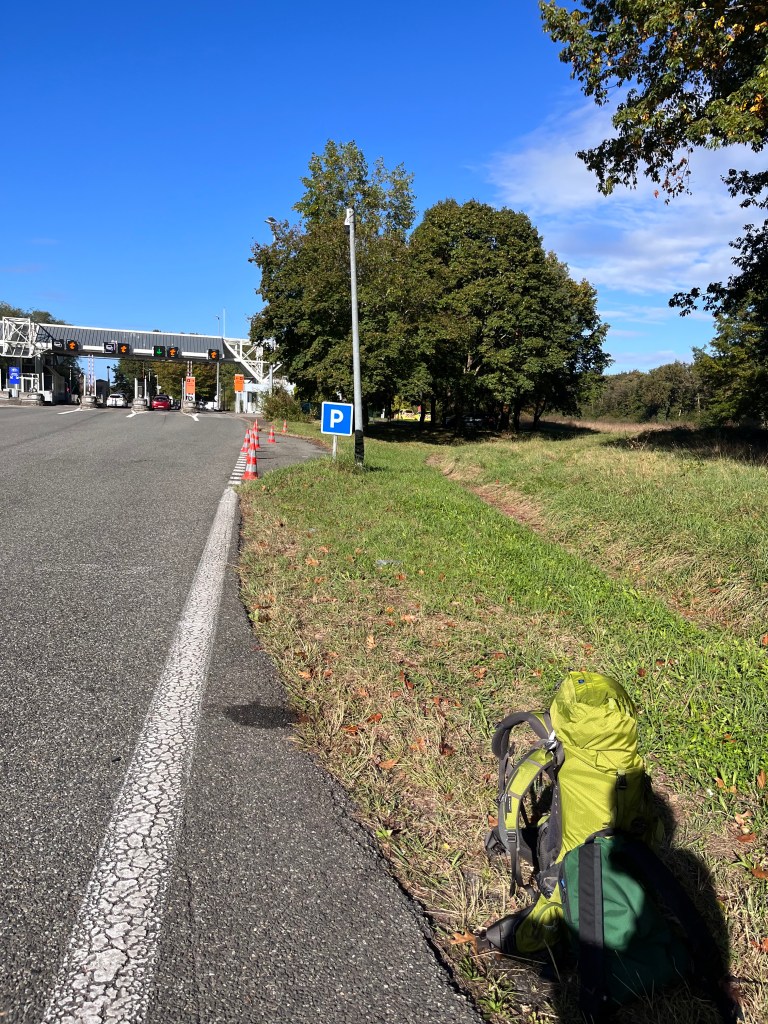
After forcing myself up, I ate a piece of bread for breakfast, I cleaned the apartment as best as I could, and set off running down the street as fast as my bags could allow me, to catch a bus that was heading towards a roundabout out west, and one that wouldn’t come for another 45 minutes. I remember it as a beautifully sunny day, with the Pyrenees mountains finally coming into clear view for the first time since I arrived in the area. I was feeling very confident that I’d have no problems getting any sort of ride. I did slightly overshoot the planned roundabout, but after catching another bus, I ended up in front of a toll station — The perfect place to catch cars as they slow down to pay the French highway toll or Péage.
The first ride of the day came from a father and his son, who literally pulled over 30 seconds after I began sticking my thumb out. Good news for me, because apparently it was illegal to hitchhike right in front of the Péage like I did (and continued to do). I got into the back of their dilapidated white van, and if it weren’t for their 10-year-old son in the front passenger seat, I would have had the impression that this was the last hitching ride of my life. They kindly took me to a better spot for heading west, much like before, then dropped me off at the exit of a toll station, without having said much to me.
I now stood at the exit of the Péage, after the cars paid the toll, and began their acceleration towards the highway. My sign, this time with the word ‘BAYONNE’, was the only thing in my hands. My large, green bag lay on the ground at my side. A mere 10 minutes of waiting already provided me with an opportunity. A middle-aged man with a fairly harmless-looking face pulled over and offered to take me straight to Bayonne. After a quick consultation with my judgment, I deemed it all alright and not overly creepy, and I jumped in the passenger seat. The conversation began immediately.
He was a Frenchman living in Chicago with his wife and kids, and he was currently back in France visiting family. He had worked his entire professional life as a chef at a luxury restaurant in the U.S., and his personal stories ranged from backpacking in Mexico in the 1970s to traveling through Australia and surfing around the world. I think my explanation of how I ended up on the side of the road appealed to his sense of adventure as well, since he seemed to want to impress me with his travel stories, which he kept dishing out the rest of the hour and a half ride to the coast.
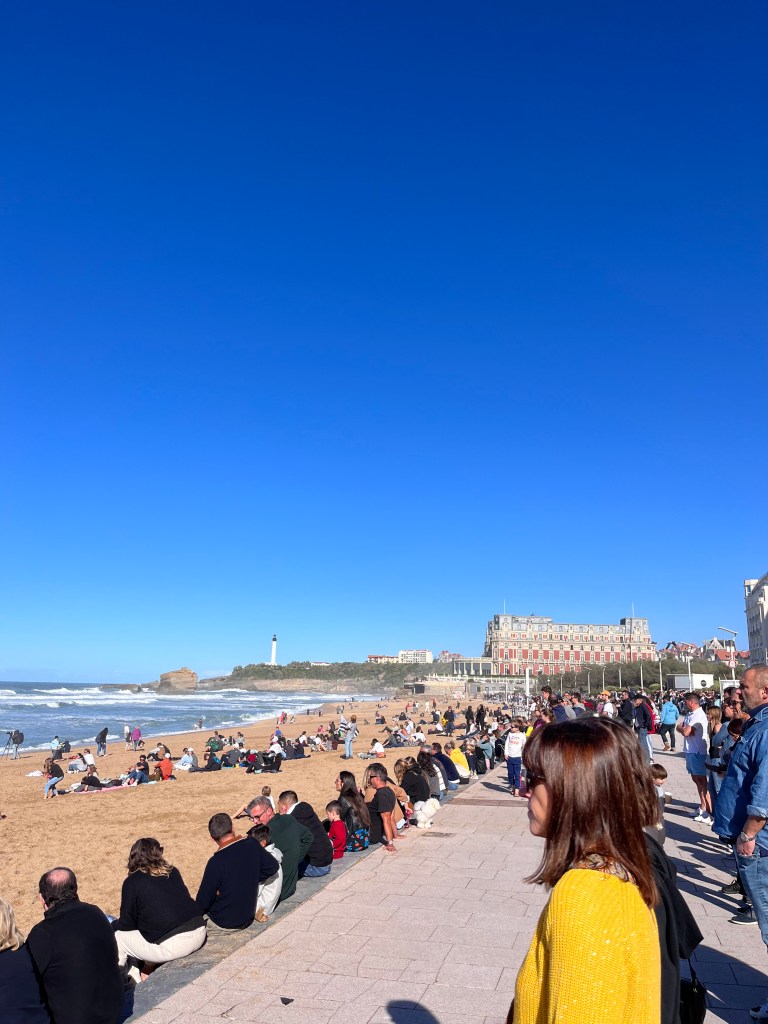
On this beautiful day—his last before flying home—he asked if I was open to grabbing lunch. Since I was already arriving at the coast hours earlier than I had planned, and running on nothing but a few pieces of baguette, I happily agreed. To my surprise, he took a detour to the famously lavish seaside resort town of Biarritz, where we sat down for a lunch of oysters, steak frites, and foie gras on a table right in front of the beach. We spoke some more about travel and work, while I gave my full attention to the plate of food in front of me. I have to admit, I couldn’t wait to tell this story to friends and family—it was almost too good to be true. I even had to laugh in the mirror when I excused myself to the bathroom during lunch. The man—whose name I’ve since forgotten—took me to the center of Bayonne just after our lunch, and all I could do was thank him in return for his ride and our nice meal by the beach.
But, of course, my luck couldn’t last forever, and my expectation of finding another English-speaking, multi-millionaire retiree to take me north to Bordeaux was just that—a fantasy. On the morning I left Biriatou, I was even more sure of myself than I ever had up until this point. And really, why wouldn’t I have been? I had just started hitchhiking, and on average, I only had to wait 10 minutes before getting a ride. If I already got a free meal out of it as well, the odds were that there were dozens more opportunities to eat good food, meet more people, and fulfill my dream of traveling like a true vagabond.
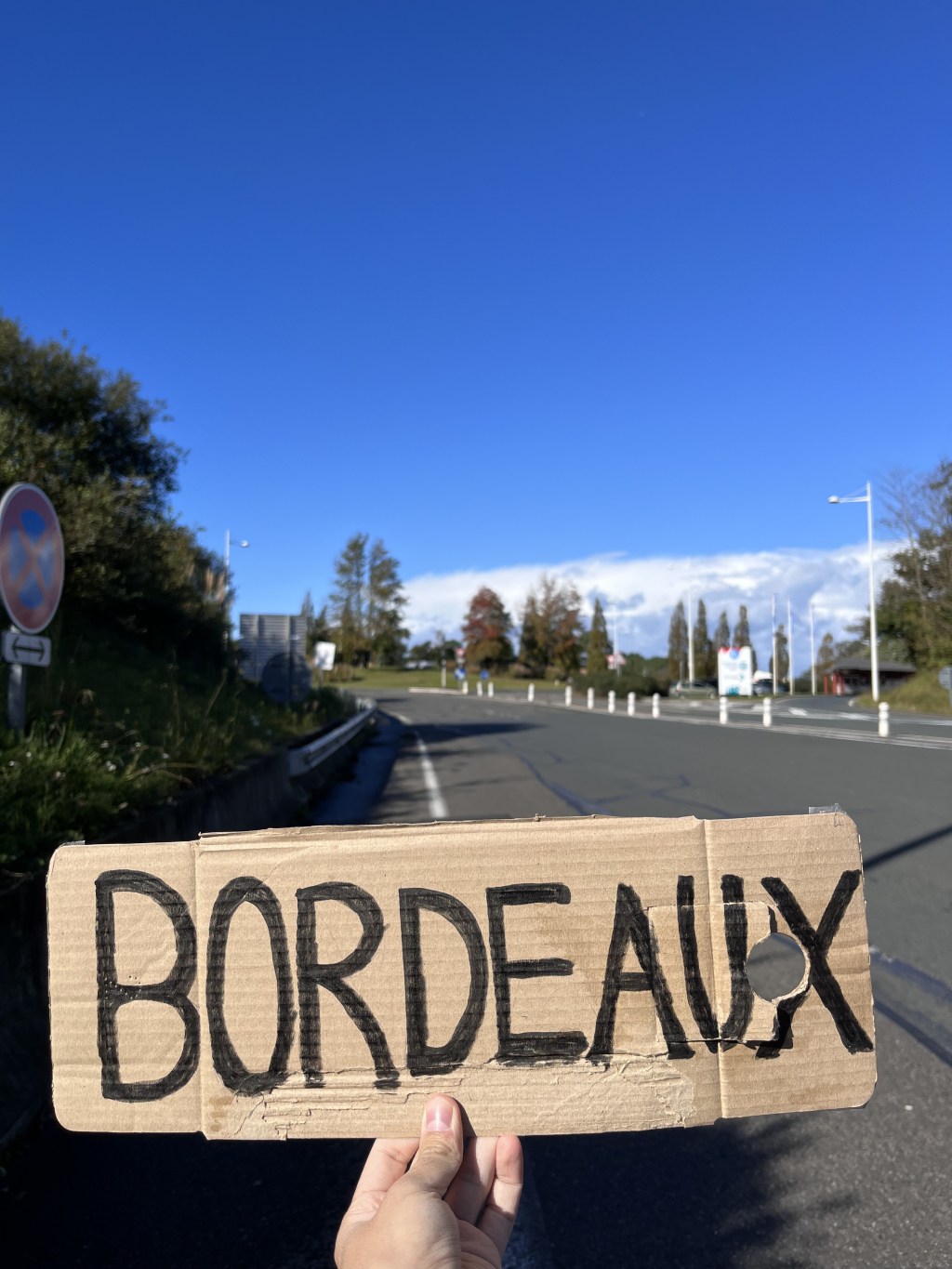
I had joked with my friends’ family the night before I left the village of Biriatou about my cardboard sign. This time, I made two signs for good measure: one with ‘BAIONA’ and the other with ‘BORDEAUX’. Both cities were north of where I was, so if getting a ride four hours up to Bordeaux proved difficult, I hoped to first catch a shorter lift, just 30 minutes to Bayonne—if I even needed the sign. I wrote ‘BAIONA’ in Basque instead of the French, feeling so confident in my success that it only served as a little joke between me and my friend Illiana.
The reality set in soon enough. I got my first ride from a trucker, who took me to a Péage, just north of Biriatou, somewhere near the town of Saint-Jean-De-Luz. It was at this stop that I found my troubles. I wasn’t sure what was happening, but alternating between my two cardboard signs was doing nothing to help me get a ride. As the hour mark was approaching, I was still standing at the same toll station, now feeling confused, frustrated, and a bit worried.
Memories of standing for an hour on the road in front of Jérico came rushing back. Nearly two hours passed as I waited on the roadside, my smile becoming harder to force and my thumb growing numb from the cold. All I received from passing motorists in return were jeers and laughter— not a single person pulled over.
I even remember seeing a man on a motorbike stick out his thumb at me, mimicking my pose, only to mime himself sticking it up his ass as he drove off. It’s funny looking back at it. But it was around this time that I thought that maybe it was the result of something I did wrong. Was it the spot? Was it my sign? Did I look smelly and disheveled this time around? But I had, and still have, no explanation for why my luck changed so drastically that day.
Admittedly, I might have been in a bad spot, but I prefer to believe it was just a game of odds. You can’t always win. Defeated, I walked down the road with my head hanging low, and I was lucky enough to find a bakery to shelter me from the cold. I sat down and called my friend, whose house I had just left that morning, and I tucked into a quiche to soothe myself. An hour later, she came by, picked me up, and took me to the train station in Hendaye. It was there, while I sat near the platform waiting for my train to Bordeaux, that I cried for the first and only time while I was abroad for 7 months. The disappointment was immense.
Altogether, I hitchhiked from Montpellier to the Atlantic coast near Bayonne, France—a distance of around 270 miles. After which, I returned to taking FlixBuses north until I reached Amsterdam, around 3 weeks later.
As I write and recollect these memories from the safety of my room in Brownsville, Texas, almost a year later, my brief stint hitchhiking feels like it could have been a dream. It was a very small chapter in the broader scheme of my time abroad—neither as life-changing as I had idealized, nor as insignificant as just another travel memory. I respect it for what it was: a lesson in moving into unknown territory for the sake of pushing myself into discomfort and building the confidence to see it through. But, sometimes I have to remind myself that it did happen.
I recognize that I gave up trying to hitchhike after facing my first real challenge on the road, but in hindsight, I was content to leave it there. I had already achieved my goal of hitchhiking multiple times, and I did so with huge success. Despite the disappointment of not continuing my journey through France as a wanderer, I still felt proud of what I had accomplished up to that point. At least, at the end of the day, I answered my burning personal question — If I was capable of doing such a thing in the first place.
Even now, as I look at the art easel next to my bed, where that piece of cardboard with the word ‘TOULOUSE’ written in elongated letters sits among a multitude of hand-drawn maps and unfinished canvases, I can’t help but be reminded of a mantra I used to repeat to myself while on the road, throughout all sorts of tough situations I found myself in during my 14 months solo-traveling, and one I undoubtedly recited to myself while I stood freezing outside of Saint-Jean-De-Luz — ‘If I can get through this, I can get through anything.’
 The Window Seat
Leave a comment